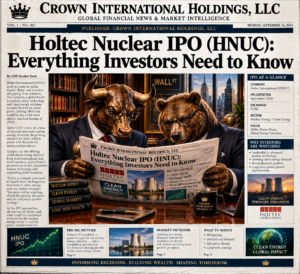
Holtec Nuclear IPO (HNUC): Everything Investors Need to Know
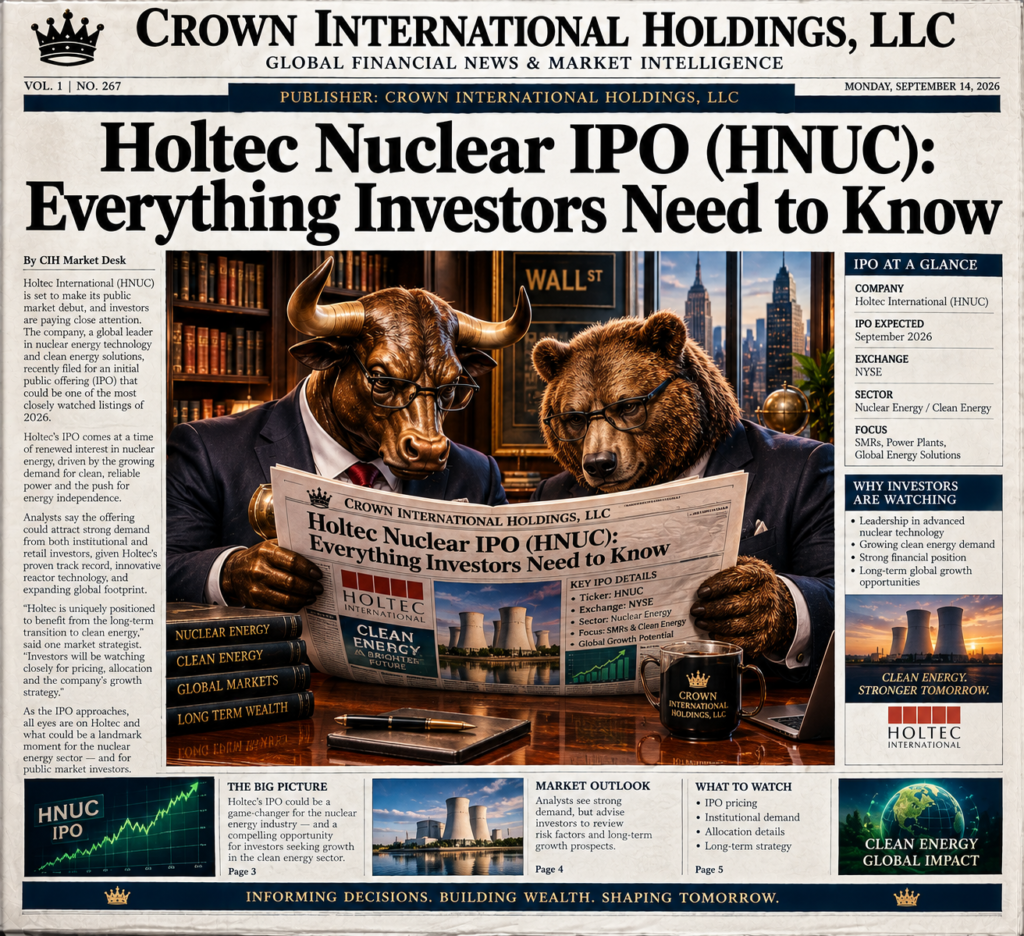
Holtec Nuclear IPO (HNUC): Everything Investors Need to Know
Holtec Nuclear Corporation is going public. The nuclear energy company is seeking an IPO on Nasdaq under the ticker HNUC, and it’s one of the most closely watched nuclear sector offerings of 2026.
But is the Holtec Nuclear IPO a good investment? Here’s a complete breakdown of the company, the valuation, the SMR-300 reactor, the Palisades restart, and the risks every investor should know before buying HNUC stock.
Holtec Nuclear IPO: Key Facts
- Company: Holtec Nuclear Corporation
- Ticker: HNUC (Nasdaq and Nasdaq Texas)
- IPO size: 50,000,000 shares of Class A common stock
- Price range: $15.00–$18.00 per share
- Maximum raise: Up to $900 million
- Implied market cap: ~$9.35 billion (at midpoint)
- Underwriters: J.P. Morgan, Guggenheim Securities, Goldman Sachs, Citigroup, BofA Securities, Morgan Stanley, Cantor, BMO Capital Markets, Oppenheimer & Co.
- SEC filing: Form S-1/A (Amendment No. 2), filed September 8, 2026
What Is Holtec Nuclear Corporation?
Holtec Nuclear Corporation is a U.S.-headquartered nuclear technology company founded in 1986 by Dr. Krishna P. Singh. Headquartered in Camden, New Jersey, Holtec specializes in nuclear power generation, spent fuel management, decommissioning, and small modular reactor (SMR) development.
Unlike many nuclear startups, Holtec is not a pre-revenue company. It has nearly four decades of operating history, more than 4,150 employees, and customers in over 40 countries.
Holtec’s Four Core Business Lines
- Spent nuclear fuel management — storage and transportation systems
- Nuclear plant restart and decommissioning — including the Palisades restart
- Small modular reactors (SMRs) — the proprietary SMR-300 design
- Clean energy and long-duration storage — Holtec Green Boiler and HI-THERM HCSP
Holtec Market Share
- >90% U.S. market share in wet spent fuel storage
- ~75% U.S. market share in dry spent fuel storage for operating plants
- 203 granted patents worldwide
- 150+ commercial nuclear reactors served globally
Holtec Nuclear Financials: Revenue and Profitability
Holtec’s financials show a company in transition — strong legacy revenue, but declining top-line performance ahead of its SMR growth phase.
| Metric | 2025 | 2024 | Change |
|---|---|---|---|
| Revenue | $576.6 million | $765.5 million | –24.7% |
| Gross Profit | $199.5 million | $332.8 million | –40.1% |
| Net Income | $386.6 million | $595.8 million | –35.1% |
Important context: Holtec’s net income is heavily influenced by its ~$2.8 billion nuclear decommissioning trust funds**, which generate investment gains. On a pro forma basis — after accounting for the IPO, the Holtec Asia spin-off, and the decommissioning asset restructuring — 2025 revenue was **$893.4 million and net income was $200.3 million. These pro forma figures are illustrative, not guaranteed.
The SMR-300: Holtec’s Growth Story
The SMR-300 is Holtec’s proprietary Generation III+ pressurized water reactor, with an expected net output of 300–340 MW per unit.
Unlike many SMR developers pursuing radical new designs, Holtec chose a proven light-water reactor pathway. This reduces technical risk but means Holtec will compete primarily on cost control and execution.
SMR-300 Deployment Plans
- Palisades (Michigan): Pioneer One and Pioneer Two — two SMR-300 units, 680 MW total
- Oyster Creek (New Jersey): Four SMR-300 units, 1,360 MW total, targeting full commercial operation by 2036
- DOE Tier 1 First Mover Award: $400 million grant (conditional on funding agreement)
New Jersey lifted its four-decade nuclear construction ban in April 2026, enabling the Oyster Creek SMR project.
Palisades Restart: Holtec’s Near-Term Catalyst
The Palisades nuclear plant restart is Holtec’s most important near-term milestone. If successful, it will be the first shuttered U.S. nuclear plant ever to restart.
- Capacity: 805 MW pressurized water reactor
- Shutdown: May 2022
- Fuel loading began: Late August 2026 (204 fuel assemblies)
- DOE loan guarantee: Up to $1.52 billion (tranche-based, tied to milestones)
- Michigan state support: $300 million
- Power purchase agreements: Wolverine Power Cooperative, Hoosier Energy
- Counterparty commitment date: March 2027
Why it matters: Palisades validates Holtec’s operational credibility and provides the platform, workforce, and licensing experience for SMR-300 deployment.
Holtec Nuclear Governance: Founder Control
This is where the Holtec Nuclear IPO gets complicated for public investors.
Following the IPO, Holtec Holdings — affiliated with founder and CEO Dr. Krishna P. Singh — will control approximately 99% of voting power through Class B shares carrying 10 votes each with no economic rights.
Key governance facts:
- Public shareholders own a minority economic interest with effectively no voting voice
- Holtec will qualify as a “controlled company” under Nasdaq listing rules
- The company reserves the right to use controlled-company governance exemptions (no independent compensation or nominating committees required)
- Holtec is electing “emerging growth company” (EGC) status — reducing disclosure requirements, exempting it from say-on-pay votes, and exempting auditor attestation of internal controls
The NAMCO/DEAMCO Restructuring: Related-Party Risk
A critical detail in the Holtec Nuclear S-1 is the NAMCO/DEAMCO restructuring:
- Phase I: Decommissioning assets and liabilities transferred from the company to DEAMCO, a subsidiary of the founder’s affiliate (Holtec Holdings)
- Phase II: Requires NRC and other regulatory approvals; may not close before the IPO
- Post-Phase II: Holtec expects to earn decommissioning revenue through a services contract with DEAMCO — a related party
Why this matters: The terms of the DEAMCO services contract will directly determine revenue. This is the kind of related-party arrangement that raises questions about transfer pricing and value capture.
Holtec Nuclear Valuation vs. Reality
At the midpoint of the IPO range, Holtec is seeking a ~$9.35 billion market cap** on **$577 million in 2025 revenue — a price-to-sales ratio of roughly 18x.
That valuation is justified almost entirely by the forward SMR narrative, not current earnings.
For context:
- Vogtle (U.S.) cost roughly $15,000 per kW to build
- Holtec’s SMR-300 target: $7,500–$8,500 per kW — less than half
Hitting that target requires factory-built, repeatable construction at a scale no one has demonstrated in the U.S.
Holtec Nuclear IPO Risks: What Investors Should Know
- Extreme founder control — ~99% voting power with no economic downside for Class B holders
- Related-party decommissioning carve-out — DEAMCO services contract terms unknown
- Pre-commercial technology — SMR-300, Green Boiler, and HI-THERM HCSP have never been commercially deployed
- Palisades execution risk — first-ever U.S. plant restart, hard March 2027 deadline
- DOE loan guarantee conditions — tranche-based funding tied to milestones
- Emerging growth company status — reduced disclosure for investors
- Up-C structure complexity — potential Tax Receivable Agreement (TRA) liability
- Growth-story valuation on legacy financials — 18x sales on declining revenue
- Dilution risk — 7.5 million over-allotment shares + directed share program
- Counterparty concentration — long-duration contracts with utilities and government entities
Is the Holtec Nuclear IPO a Good Investment?
The Holtec Nuclear IPO (HNUC) is a high-risk, high-reward proposition.
The bull case: Holtec has real revenue, dominant market share in spent fuel storage, a $1.52 billion DOE loan guarantee, and a first-mover advantage in U.S. nuclear plant restart. If SMR-300 succeeds, the upside is substantial.
The bear case: The valuation depends entirely on a future that is years away and technically unproven. Founder control is extreme, related-party transactions raise governance concerns, and first-of-a-kind nuclear construction has a long history of cost overruns.
The bottom line: HNUC is not a “set it and forget it” stock. It’s a levered bet on nuclear execution — on Palisades restarting on schedule, on NRC approvals, on construction costs landing far below precedent, and on utilities signing up for SMR-300 reactors. It is not suitable for capital you cannot afford to see decline significantly.
Holtec Nuclear IPO: Frequently Asked Questions
What is the Holtec Nuclear IPO price range?
$15.00–$18.00 per share of Class A common stock.
What stock symbol will Holtec Nuclear trade under?
HNUC, on Nasdaq and Nasdaq Texas.
How much is Holtec Nuclear raising in its IPO?
Up to $900 million (50 million shares at up to $18 each).
What does Holtec Nuclear do?
Holtec is a nuclear technology company focused on spent fuel management, plant restart and decommissioning, SMR-300 development, and clean energy storage.
Who controls Holtec Nuclear after the IPO?
Founder Dr. Krishna P. Singh’s affiliate, Holtec Holdings, will control approximately 99% of voting power through Class B shares.
Is Holtec Nuclear profitable?
Yes, on a reported basis — $386.6 million net income in 2025 — though results are heavily influenced by decommissioning trust fund investment gains.
When will the Holtec Nuclear IPO happen?
The S-1/A was filed September 8, 2026. The offering will commence after the SEC declares the registration statement effective.
Final Thoughts on HNUC Stock
The Holtec Nuclear IPO offers investors exposure to one of the few nuclear companies with both an established revenue base and a credible SMR growth story. But the founder-controlled structure, related-party transactions, and pre-commercial technology mean the risks are as significant as the potential rewards.
For investors evaluating HNUC stock, the most important sections of the S-1 are the Risk Factors (page 35), the DEAMCO services contract terms, and any Tax Receivable Agreement disclosures. The gap between the summary and the fine print is usually where the real story lives.
Disclaimer: This article is for informational purposes only and does not constitute investment advice. All investments carry risk, including the potential loss of principal. Consult a licensed financial advisor before making any investment decision.