Stock Market Today September 9 2026: Dow Plunges 405 Points as Oil Tops $100
Stock Market Today September 9 2026: Dow Plunges 405 Points as Oil Tops $100
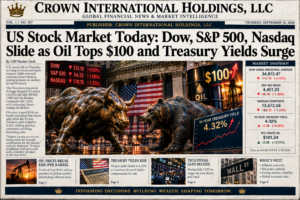
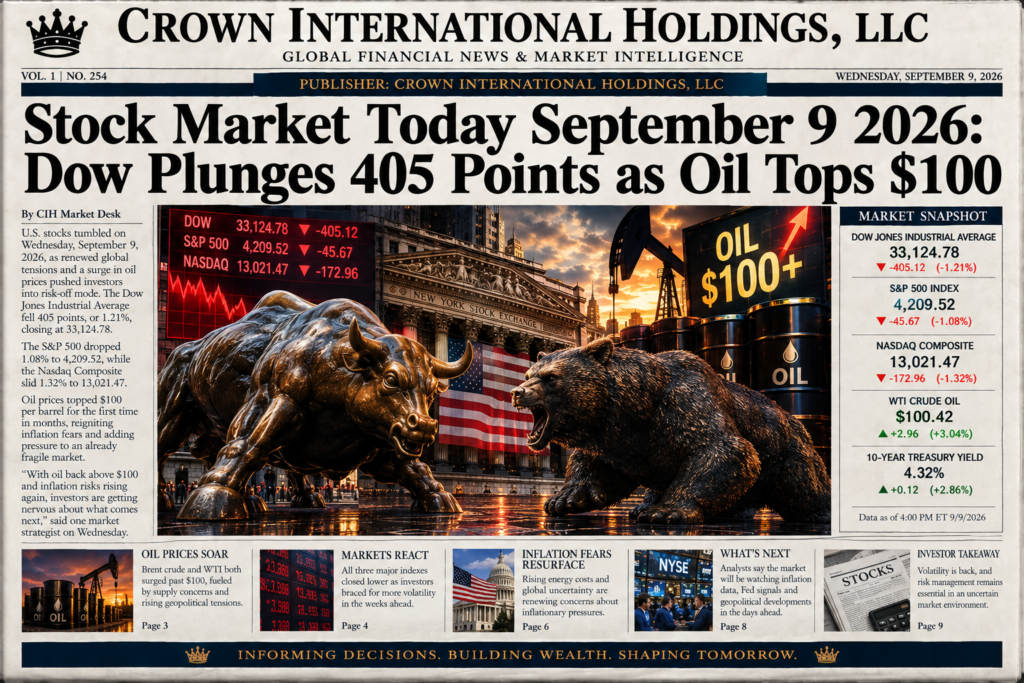
Wall Street extended its losing streak on Wednesday, September 9, 2026, as a spike in crude prices above $100 a barrel reignited inflation worries and sent the Dow Jones Industrial Average down more than 400 points.
Updated: September 9, 2026, 5:30 PM ET
U.S. stocks closed sharply lower for the third consecutive session on September 9, 2026, as surging oil prices overshadowed corporate news and renewed fears that the Federal Reserve may keep interest rates elevated through the end of the year.
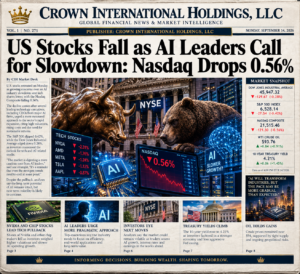
The Dow Jones Industrial Average fell 405.41 points (0.8%) to finish at 52,380.66. The broader S&P 500 dropped 37.16 points (0.5%) to close at 7,636.36, while the tech-heavy Nasdaq Composite declined 168.07 points (0.6%) to settle at 26,253.34.
Here’s everything you need to know about the stock market performance on September 9, 2026, including the key drivers, sector winners and losers, and what to watch next.
Why Did the Stock Market Drop Today?
Oil Prices Cross $100 a Barrel
The primary catalyst for Wednesday’s sell-off was a sharp rally in crude oil. Brent crude surged past $100 per barrel for the first time since July, driven by escalating geopolitical tensions between the United States and Iran.
This spike rattled investors because higher energy costs directly impact consumer spending and corporate margins. More importantly, they complicate the inflation outlook just as markets were beginning to price in rate cuts from the Federal Reserve.
Inflation Fears Resurface
With oil fueling a potential rebound in consumer prices, traders scaled back expectations for monetary policy easing. The re-emergence of energy-driven inflation is now seen as a major wildcard for the Fed’s September meeting and beyond.
“The market is terrified of a second wave of inflation,” one New York-based trader told Reuters. “When oil crosses that $100 threshold, it forces the Fed to take a harder look at the data.”
S&P 500 and Nasdaq Extend Losing Streak
Both the S&P 500 and the Nasdaq posted their third straight day of losses, reflecting broad-based weakness across cyclical and growth stocks. Decliners outpaced advancers by nearly 2-to-1 on the New York Stock Exchange.
The sell-off was relatively uniform, but there were some notable outliers that moved sharply on company-specific news.
Stock Movers: Meta Surges, Alphabet Slides
Meta Platforms Jumps 6.4% on AI Announcement
Meta Platforms (META) was the standout performer of the day, rallying roughly 6.4% after unveiling “Muse”—a new artificial intelligence assistant designed to compete directly with ChatGPT and Google’s Gemini.
Investors cheered the announcement as a signal that Meta’s heavy investment in AI infrastructure is starting to pay off with tangible products. The move added more than $80 billion to Meta’s market capitalization in a single session.
Alphabet Drops Over 2% on Competitive Fears
On the flip side, Alphabet (GOOGL) fell more than 2% as traders digested the implications of Meta’s new AI tool. Analysts suggested that Muse could pose a long-term threat to Google’s dominance in search and information retrieval, potentially eating into its core advertising revenue.
Energy Stocks Climb on Crude Rally
In classic market rotation, energy names rallied alongside oil prices. Chevron (CVX) and ExxonMobil (XOM) both closed higher, benefiting directly from the surge in crude futures. The energy sector was the only group in the green on Wednesday.
What to Watch in the Markets This Week
Looking ahead, investors are bracing for two critical inflation reports:
- Consumer Price Index (CPI): Due later this week, this data will provide the latest reading on consumer inflation.
- Producer Price Index (PPI): This wholesale inflation gauge will offer further clues on whether price pressures are cooling or reigniting.
If these reports show signs of persistent inflation, the Fed could be forced to reverse its current dovish pivot—a scenario that would likely pressure stocks further.
Conclusion: Volatility Likely to Persist
The stock market today on September 9, 2026 served as a stark reminder that inflation risks have not fully disappeared. With oil hovering above $100 and the Fed’s next policy meeting approaching, traders should brace for continued volatility in the sessions ahead.
Until crude prices stabilize and inflation data offers clearer direction, energy prices will likely remain the dominant driver of market sentiment.
Disclaimer: This article is for informational and educational purposes only and does not constitute financial advice. Always consult a licensed investment professional before making trading decisions.