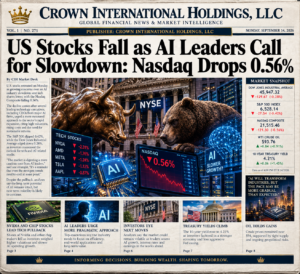
US Stocks Fall as AI Leaders Call for Slowdown: Nasdaq Drops 0.56%
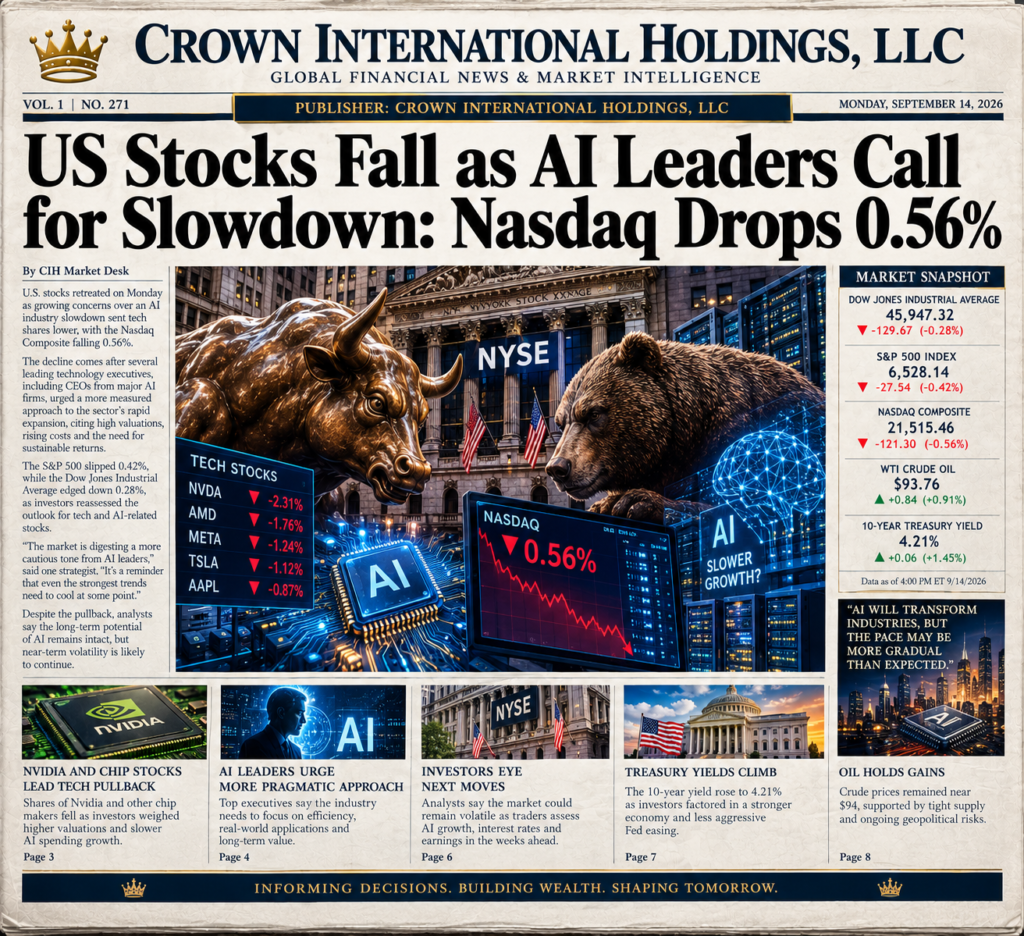
US stock market today, stock market close September 14 2026, Nasdaq drop, S&P 500 decline, Dow Jones fall, AI stocks selloff, semiconductor stocks plunge, AI slowdown, AI regulation, Nvidia stock, AMD stock, Intel stock, Micron stock
NEW YORK — U.S. stocks closed lower on Monday, September 14, 2026, as an unprecedented public plea from three rival AI executives to slow down frontier model development triggered a sharp selloff in semiconductor and AI infrastructure shares, while surging oil prices and a spike in Treasury yields compounded investor anxiety.
The tech-heavy Nasdaq Composite fell 0.56% to close at 26,186.41, while the S&P 500 declined 0.48% to 7,619.98. The Dow Jones Industrial Average dropped 0.29% to 52,421.20 .
The AI Catalyst: A Rare Consensus
The selloff was sparked by coordinated calls from Anthropic CEO Dario Amodei, OpenAI CEO Sam Altman, and xAI founder Elon Musk urging the industry to slow the pace of artificial intelligence development. Amodei warned that within a year, an AI agent “swarm” could potentially take over the entire internet . Altman posted on X that “we could lose control of the future to AI” and that “AI must always serve people” . Musk also publicly agreed, stating “Dario is right” .
The message — coming from the very leaders building the most advanced AI systems — rattled investors who have poured billions into the AI infrastructure trade.
President Trump pushed back on the warnings, posting on Truth Social that the only AI guardrails necessary are a “STRONG AND SMART (High IQ!) PRESIDENT,” adding that “whoever wins AI wins” . His comments briefly helped stocks recover from their lows, but the AI selloff continued.
Semiconductor Stocks Hit Hardest
The Philadelphia Semiconductor Index sank approximately 5-6% intraday, its worst session since July . Individual chip stocks suffered steep declines:
- Micron Technology (MU): down 7.4%
- Intel (INTC): down 7%
- Marvell Technology (MRVL): down 8%
- AMD (AMD): down 5%
- Nvidia (NVDA): down 3.37% to $210.94
- Broadcom (AVGO): down 3.9%
AI infrastructure names also tumbled. Corning (GLW) plunged 13.7%, Teradyne (TER) lost 13.3%, and Hewlett Packard Enterprise (HPE) dropped 10.77% .
A Clear Divergence Within Tech
Despite the broader index declines, a modest majority of S&P 500 stocks actually closed positive . The selloff was concentrated in AI infrastructure, while software and cybersecurity stocks surged.
The iShares Expanded Tech-Software Sector ETF jumped 3.1% . CrowdStrike (CRWD) soared 13.85% to an all-time high, Palo Alto Networks (PANW) gained 13.09%, and Gartner (IT) rose 9.73% . The logic: if AI development slows, traditional software companies gain breathing room from potential AI disruption, while cybersecurity firms could benefit from heightened AI threat perceptions.
Defensive sectors also attracted buyers, with consumer staples and healthcare each rising approximately 2% .
Macro Headwinds: Oil Above $108, 10-Year Yield Hits 5%
The AI-driven selloff unfolded against a deteriorating macro backdrop.
Oil prices surged as Middle East tensions escalated, with Brent crude climbing above $108 per barrel . The spike intensified inflation concerns already running high ahead of the Federal Reserve’s September 15-16 meeting.
The 10-year Treasury yield briefly breached 5% for the first time since October 2023, a psychologically significant threshold that analysts warn could threaten the bull market by denting the relative appeal of equities . The yield later retreated to around 4.94% as buyers emerged .
Fed rate hike odds remained elevated, with markets pricing approximately 90% probability of a 25-basis-point increase at this week’s meeting . The combination of rising rates, surging oil, and AI uncertainty created a “perfect storm” for risk-off sentiment.
What Analysts Are Saying
Market strategists cautioned against overinterpreting the selloff as a fundamental rejection of AI. Barron’s noted that “Wall Street often takes a ‘shoot first, ask questions later’ approach to the AI trade,” suggesting the reaction may be more about positioning than a genuine reassessment of long-term AI demand .
The key question going forward: whether the AI slowdown calls represent a temporary sentiment shock or the beginning of a structural repricing of AI infrastructure valuations. With the Fed decision looming Wednesday and oil prices remaining elevated, volatility is likely to persist in the near term.
This article was originally published on September 14, 2026.