Fed Rate Hike Shocks Wall Street: Dow Plunges 631 Points as Markets Reverse Course
Fed Rate Hike Shocks Wall Street: Dow Plunges 631 Points as Markets Reverse Course
The Federal Reserve raised rates for the first time in three years, and Wall Street experienced a dramatic day of trading.
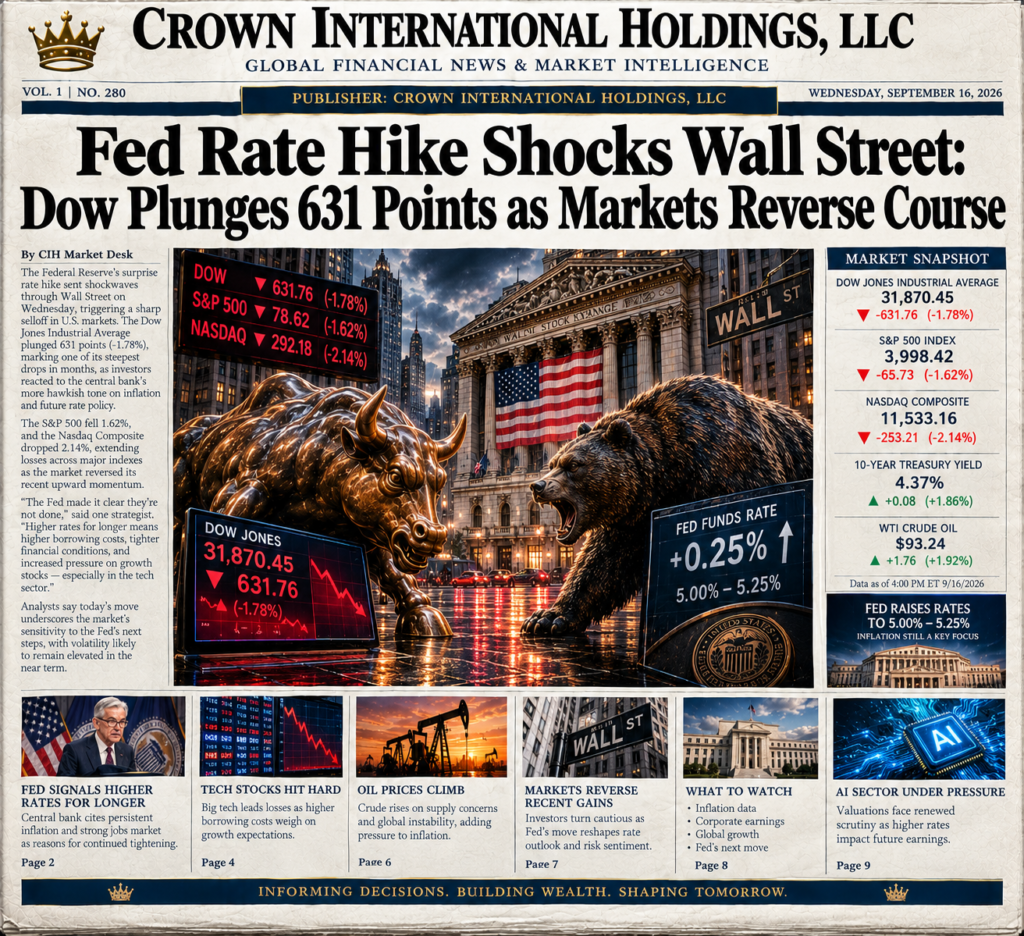
U.S. stocks ended sharply lower on Wednesday, September 16, 2026, after the Federal Reserve announced its first interest rate hike in three years. The Dow Jones Industrial Average plunged 631.21 points, or 1.2%, to close at 51,461.90 — its lowest level since June 12. The dramatic reversal came after Fed Chair Kevin Warsh struck a hawkish tone in his press conference, dashing hopes for a dovish pivot.
The Federal Reserve raised its benchmark federal funds rate by 25 basis points to a range of 3.75%–4.00%, the first increase since July 2023. More importantly, the dot plot showed that most officials expect at least one more hike before the end of the year.
How the Major Indexes Closed
| Index | Close | Change (Points) | Change (%) |
|---|---|---|---|
| S&P 500 | 7,551.81 | -33.92 | -0.4% |
| Dow Jones Industrial Average | 51,461.90 | -631.21 | -1.2% |
| Nasdaq Composite | 25,978.42 | -3.15 | Less than -0.1% |
| Russell 2000 | 2,858.81 | -11.47 | -0.4% |
The S&P 500 closed at its lowest level since August. The Nasdaq’s relative resilience was largely due to strength in technology stocks. The S&P 500 information technology sector was the only sector to finish higher, eking out a 0.1% gain. AI-related hardware names including Lumentum, Coherent, Intel, Marvell, and Dell attracted buying interest as investors continued to bet on long-term AI infrastructure demand.
Warsh’s Hawkish Remarks Trigger the Reversal
The dramatic intraday reversal was almost entirely driven by Fed Chair Warsh’s press conference.
Stocks initially held gains in the minutes following the rate decision, and Treasury yields even dipped slightly. But sentiment shifted rapidly once Warsh began speaking.
“Inflation remains too high, and it has been too high for too long,” Warsh said in his opening remarks. “The inflation data over the summer did not tell me that the underlying trend has meaningfully improved.”
He emphasized that the Fed’s primary focus is price stability. “We are focused primarily on the price stability side of our dual mandate.” That statement effectively erased any lingering hopes for a dovish signal.
Adding to market unease, Warsh declined to provide forward guidance on the policy path and did not submit his own economic projections. This “mystery-shrouded” communication style left investors struggling to gauge the Fed’s next move.
Energy and Financials Lead Declines
Among the S&P 500’s 11 sectors, energy was the worst performer, falling about 2.97% on the day.
The selloff in energy stocks stemmed from a sharp pullback in oil prices. Brent crude fell 2.53% after Saudi Arabia said its East-West pipeline could restore roughly half its capacity within days following a drone attack. The news eased supply disruption concerns but pressured energy equities.
Diamondback Energy tumbled 7.3%, Occidental Petroleum dropped 4.9%, and ConocoPhillips and EOG Resources also fell significantly.
Financials followed, declining about 0.5%. Texas Pacific Land slid 4.2%, and Huntington Bancshares lost 2.5%.
Crypto Market Hit with a “Double Blow”
The cryptocurrency market faced pressure from two directions on the same day.
Fed rate hikes are typically bearish for non-yielding assets like Bitcoin. According to Bloomberg-compiled data, in the last 10 Fed rate hikes, Bitcoin traded higher one month later in only 2 instances.
A more direct blow came from the Senate. Just one day earlier (September 15), the Digital Asset Market Clarity Act (CLARITY Act) failed to clear the Senate’s 60-vote procedural threshold, falling 50–49. The bill was seen as the crypto industry’s most systematic legislative attempt in years to provide a clear regulatory framework for digital asset trading and product development.
Under the double blow, crypto-related stocks sold off across the board. Coinbase plunged more than 10%, Circle dropped over 11%, and Strategy fell more than 5%. Bitcoin briefly broke below the $75,000 mark, with over 115,000 traders liquidated across the market.
Conflicting Signals from Bonds and Oil
One of the most intriguing details of the day was the divergence between the bond market and Fed policy.
Typically, rate hikes push short-term Treasury yields higher, but the 10-year Treasury yield did not surge as expected after the decision. MarketWatch noted that the benchmark 10-year yield ultimately closed at its highest level since July 2007, but Warsh attributed the rise in long-term yields to “a strengthening economy” rather than runaway inflation expectations.
The oil market told a different story. Despite ongoing Middle East tensions — Iran shot down a U.S. military drone in the Strait of Hormuz, and the Pentagon reported that the war with Iran has cost over $42 billion — oil prices fell sharply on the day. Saudi Arabia’s pipeline restoration news temporarily overshadowed geopolitical risks.
What’s Next for Markets?
For investors, the biggest uncertainty is how long and how aggressively the Fed will tighten.
The dot plot showed that at least 12 FOMC members expect one more hike this year, 4 expect two, and only 2 believe no further increases are needed. That means borrowing costs will continue to climb unless inflation data shows meaningful improvement.
Wells Fargo cut its year-end S&P 500 target from 7,950 to 7,700 on the day and recommended investors rotate into defensive sectors. UBS maintained a relatively optimistic stance, keeping its year-end target at 8,100, arguing that historical data shows stocks tend to be resilient after the start of a hiking cycle.
But one line from Warsh may sum up the market’s core dilemma: “Trend matters. Data points are noisy.” Until inflation shows a clear improving trend, the Fed appears unlikely to pivot — and markets will continue to trade in the shadow of policy uncertainty.